The Weekly Foreign-Policy Briefing
Briefing archive
Every edition of the newsletter, from session 2 in June 2020 to the present. Each one is the full write-up of a session — the argument, the quotes and the figures as they were given on air.
38 briefings
| Quadrant brief | Session | Date | Briefing | |
|---|---|---|---|---|
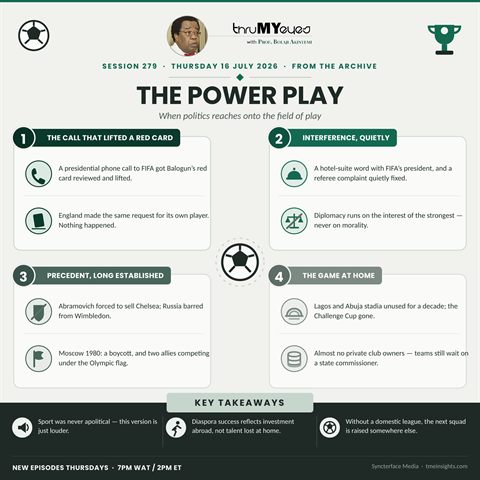 |
279 | The Power Play President Trump calls FIFA to overturn a red card at the World Cup, and a panel of guests explains why that's nothing new at all — just louder than usual. | ||
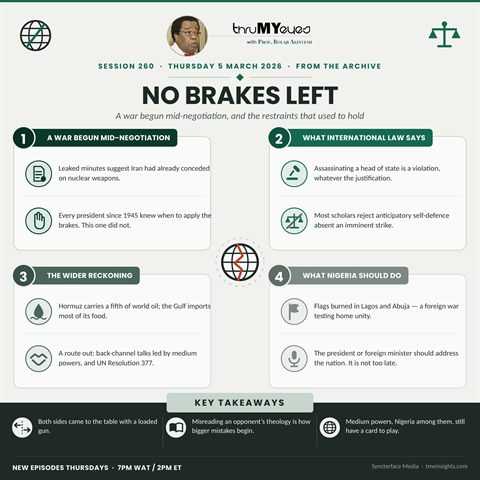 |
260 | No Brakes Left The United States and Israel attack Iran and kill its Supreme Leader. The Professor's argument is not that the war is unprecedented, but that the restraint which used to stop it has gone. | ||
| 194 | When Systems Respond Kamala Harris picks a running mate the Professor calls a near-perfect choice, Britain's courts sentence rioters within 24 hours, and Ukraine carries its war onto African soil — a week about what happens when institutions actually work, and when they don't. | |||
| 168 | The Wrong Kind Of Genius Henry Kissinger is dead, and Prof. Bolaji Akinyemi refuses to eulogize him. The year's final broadcast sets his legacy against Qatar's quieter, more effective diplomacy in Gaza. | |||
| 167 | No Permission Needed From a Gaza ceasefire brokered by a king who answers to no one to a Lamido who ended a refugee crisis with a phone call, this week asks whose authority to intervene is written down — and whose simply isn't. | |||
| 166 | Through The Back Door From a Hajj crisis defused by a phone call to the King of Morocco to a Zulu king asked to stand down, this week traces how Africa's palaces move issues embassies can't. | |||
| 164 | Forgive, Not Forget From a German apology that came with a bill attached to a British one that never arrived, this week asks what an apology is actually worth once reparations enter the room. | |||
| 160 | Someone Else Pays From a cholera apology the UN still won't give to a diaspora whose loudest voices leave the bill with people back home, this week keeps finding the same pattern: someone runs it up, someone else settles it. | |||
| 151 | No Casting Vote From a misquoted interview to a fracturing regional bloc to an indictment his base won't punish him for — this week keeps testing whether words carry any consequence at all. | |||
| 147 | What Doesn't Stay Down From a Wagner commander back in Saint Petersburg to a base no indictment can shake, this week keeps circling the same question: what actually stays buried, and what just waits out the news cycle. | |||
| 146 | Who's Actually In Charge From a Kremlin mutiny that exposed who really controls Russia's guns, to a NATO post withheld from London, to nine judges disagreeing in public — this week keeps testing what happens when the chain of command gets murky. | |||
| 145 | Built, Not Begged For From a submersible's wreck to a snub in Moscow to a quietly compounding African bank — this week's session keeps testing the same idea: standing is earned, not asked for. | |||
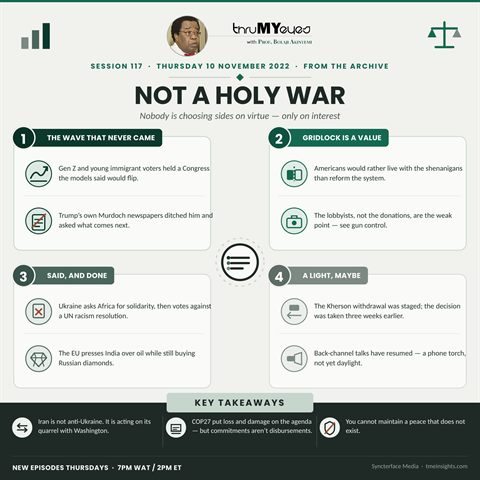 |
117 | This Is Not A Holy War American voters refuse the script, Russia leaves Kherson, and the Professor keeps returning to one point: every country is acting in its own interest, and expecting moral alignment is a category error. | ||
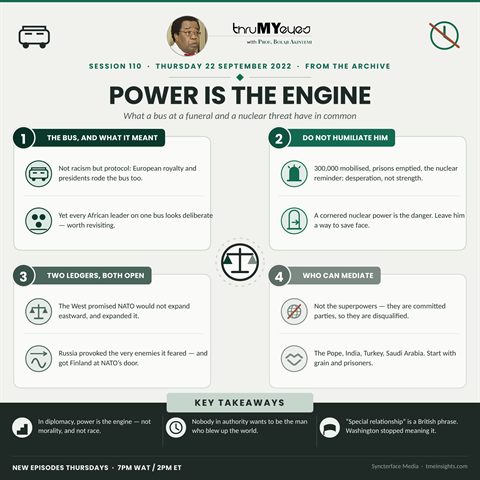 |
110 | Power Is The Engine A question about a bus at the Queen's funeral opens onto the week's real subject: what people do when they are about to be disgraced — and why humiliating a nuclear power is the most dangerous thing on the table. | ||
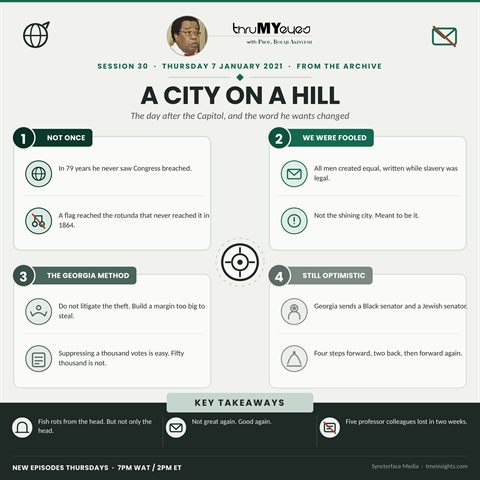 |
30 | Meant to Be a City on a Hill Seventy-nine years old and up until five in the morning watching, he says he never expected to see it. Then he does the harder thing: dismantles the idea America was ever the shining city, and explains why that is a reason to keep the phrase. | ||
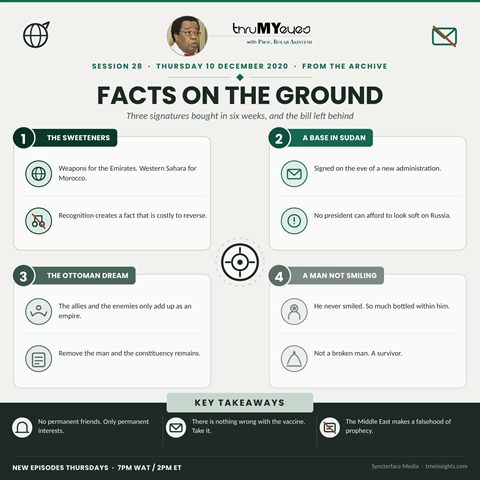 |
28 | Creating Facts on the Ground Weapons for one recognition, a disputed territory for another, and a Russian base signed in the same six weeks. He works out what each is worth — and ends on a poem, and on why a man being honoured did not smile. | ||
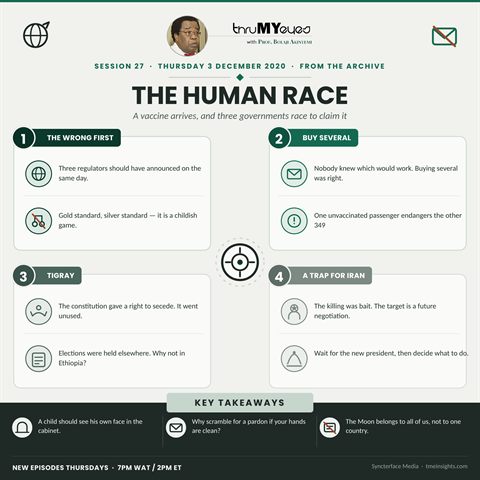 |
27 | Congratulations to the Human Race A vaccine is approved and within a day three governments are arguing about who did it first. He spends the hour separating achievements from the flags people plant on them — and returns a verdict on his own earlier criticism. | ||
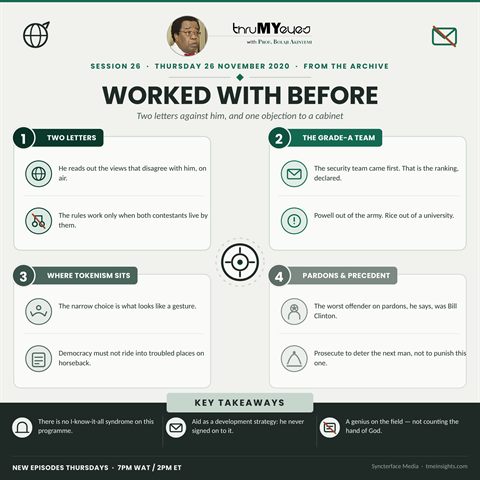 |
26 | People I Have Worked With Before He begins by reading out two letters that disagree with him — the only time in the archive so far that he does this — and then makes his own objection to a new cabinet: the phrase is being used to excuse a choice, not to explain one. | ||
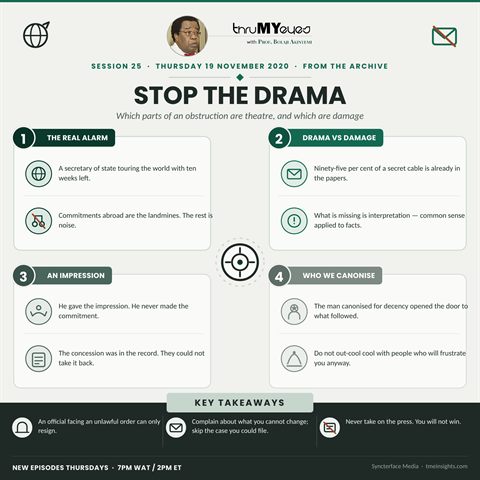 |
25 | Stop Making This Drama He sorts an obstructed transition into the parts that are theatre and the parts that are damage — and then tells the winning side, twice, that it is complaining about what it cannot change and leaving undone the one thing it could. | ||
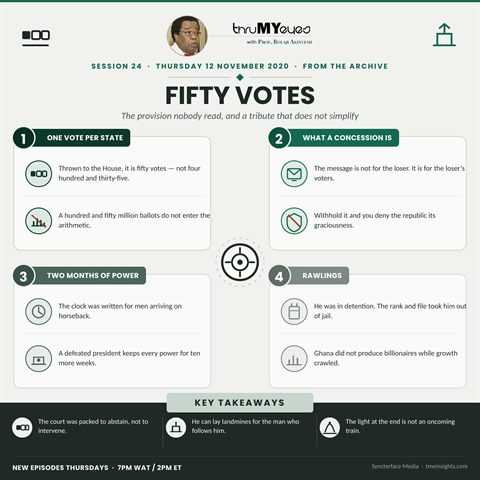 |
24 | Fifty Votes, Not A Hundred Million The provision almost nobody had read, the two months in which a defeated president keeps every power he had, and a long, complicated tribute to a man he calls not a coup but a revolution. | ||
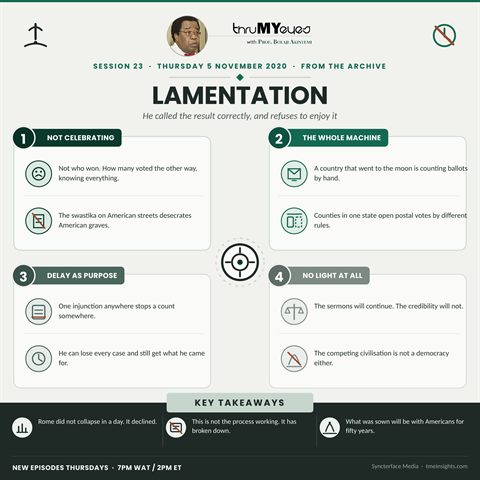 |
23 | I Am In A Mood Of Lamentation He called the result correctly and refuses to enjoy it. The distress is not about who won but about how many voted the other way, how long the counting is taking, and what a man who cannot lose gracefully can still achieve by losing slowly. | ||
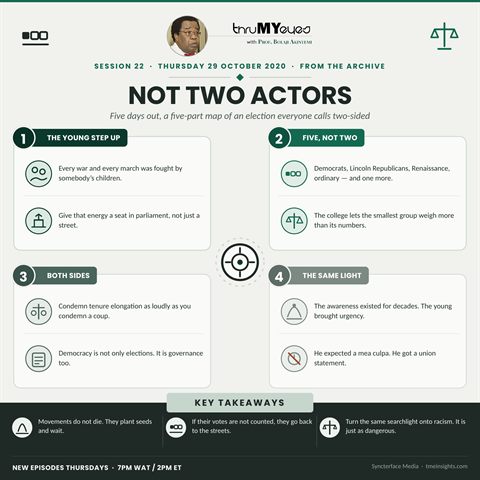 |
22 | The Major Actors Are Not Two Five days out, he refuses the two-party map of the American election and offers a five-part one instead — then explains why the smallest of the five carries more weight than its numbers, and what a refusal to concede would actually set off. | ||
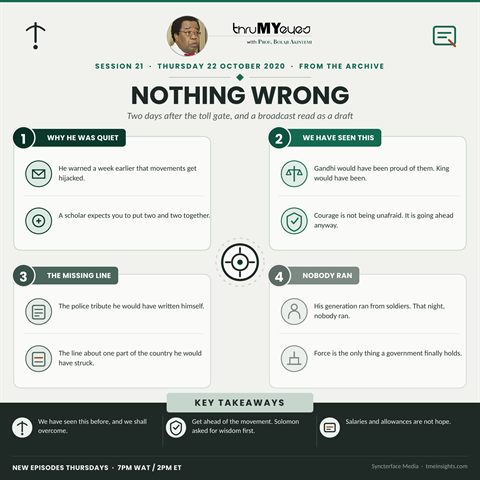 |
21 | They Did Nothing Wrong The hardest broadcast in the archive. He answers the charge that he was silent, tells the protesters what his own generation survived, and reads the president's national address the way a foreign minister reads a draft that has crossed his desk. | ||
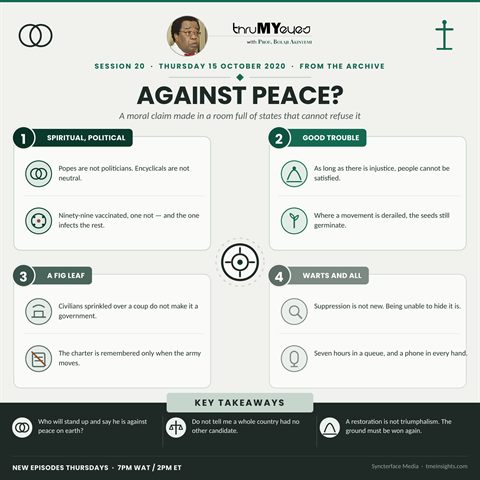 |
20 | Who Would Stand Up And Say He Is Against Peace? A viewer asks whether popes should take political positions. The answer — from a self-declared non-Catholic and non-theologian — turns into the sharpest thing said all year about why the streets are full from Bangkok to Lagos. | ||
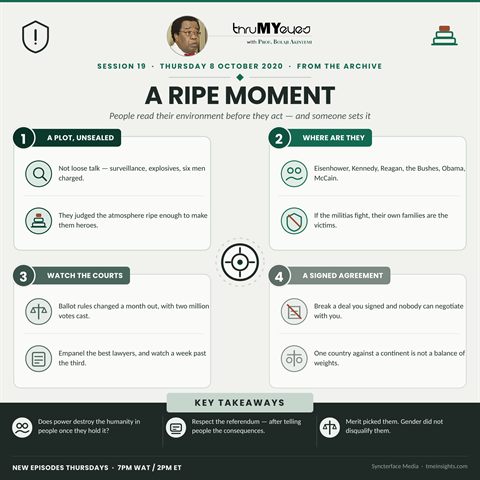 |
19 | They Felt The Moment Was Ripe A president discharged from hospital against advice, a plot to seize a sitting governor, and the observation that ties them together — that people read their environment before they act, and someone had told them what the environment was. | ||
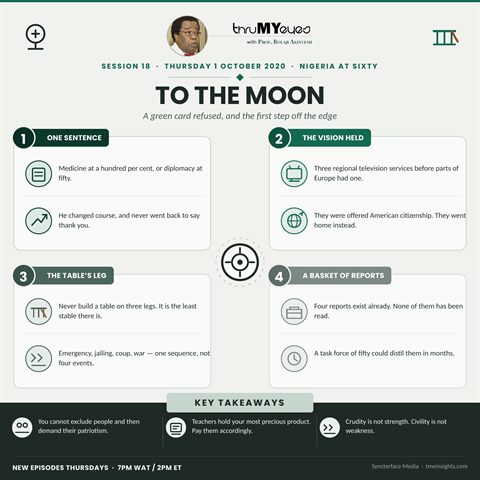 |
18 | We Thought We Were Going To The Moon Nigeria At Sixty The most personal broadcast in the archive. A green card refused, a housemaster's one sentence that redirected a career, and the single event he holds responsible for everything that followed — told on the sixtieth anniversary of the country it happened to. | ||
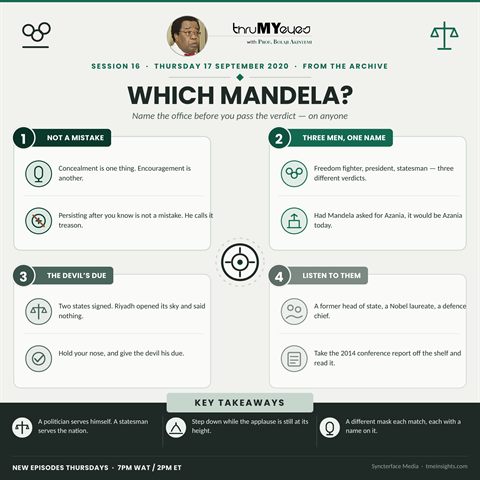 |
16 | Which Mandela Are You Judging? A rule for assessing great men — name the office before you name the verdict — applied to Mandela, to Churchill, and, before the hour is out, to a sitting American president whose conduct he declines to call a mistake. | ||
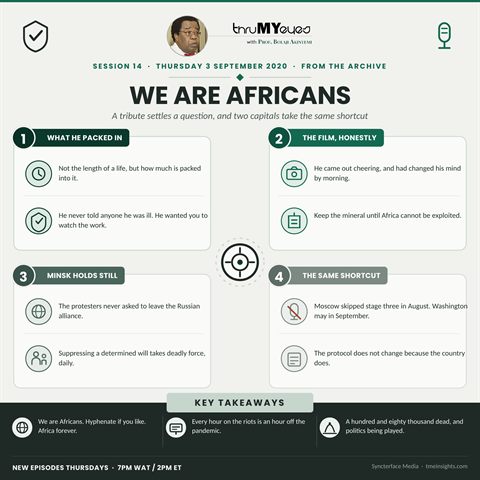 |
14 | We Are Africans. That Is Settled. A tribute to Chadwick Boseman closes a question this programme had been circling for months — and produces, along the way, the most honest piece of film criticism the archive contains: he loved the film in the cinema and had changed his mind by morning. | ||
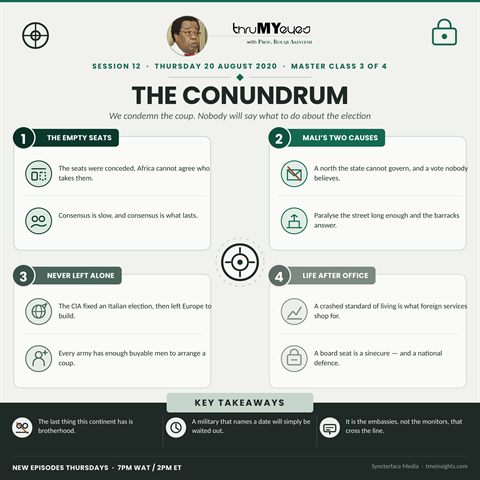 |
12 | The Conundrum He Keeps Raising Master Class 3 Of 4 The world condemns the coup in Bamako, as it should. The Professor's question is the one nobody in the condemnation has answered: what is anybody proposing to do about an election that nobody believes? | ||
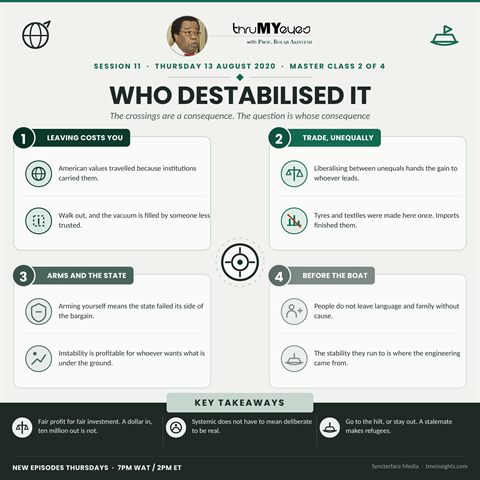 |
11 | Who Destabilised It First? Master Class 2 Of 4 The second master class edition runs from an American withdrawal from the world, through a running mate almost nobody predicted, to the question the Channel crossings actually pose — which is not who should take these people in, but who made them leave. | ||
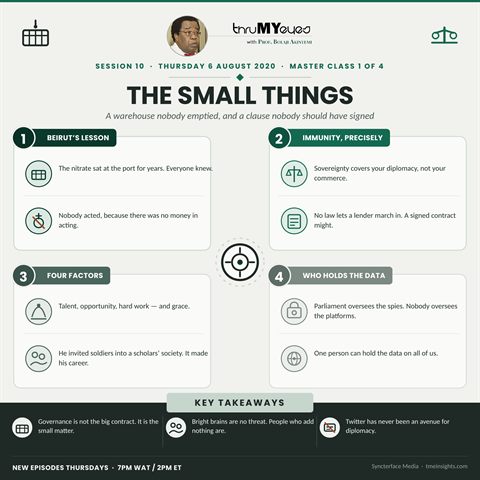 |
10 | Governance Is The Small Things Master Class 1 Of 4 The first of four master class editions. It begins with a warehouse in Beirut that nobody emptied, moves through the contract clause African parliaments were arguing about, and arrives at the four things he says actually account for a career — one of which he does not claim credit for. | ||
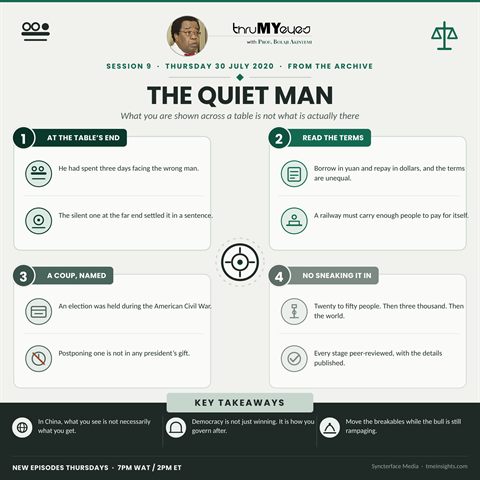 |
9 | The Quiet Man At The End Of The Table A negotiation in Beijing taught him that the person facing you across a table is not necessarily the person who decides. Thirty years later the lesson is doing work on Chinese loans, an American election, and a vaccine announced without a protocol. | ||
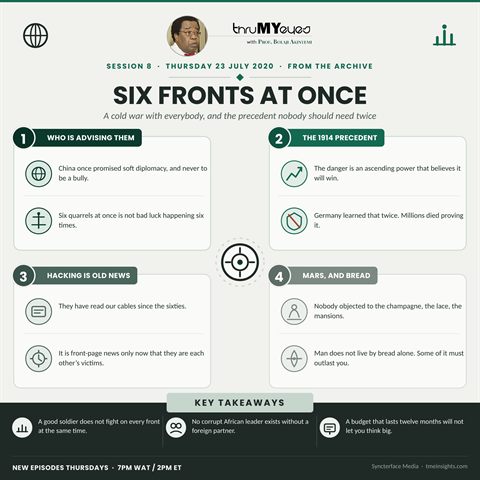 |
8 | Who Is Advising The Chinese? A scholar's bafflement rather than a strategist's alarm: not why is China quarrelling with the United States, but why is China quarrelling with everybody at once — and what happened to the country that promised it would never become a bully. | ||
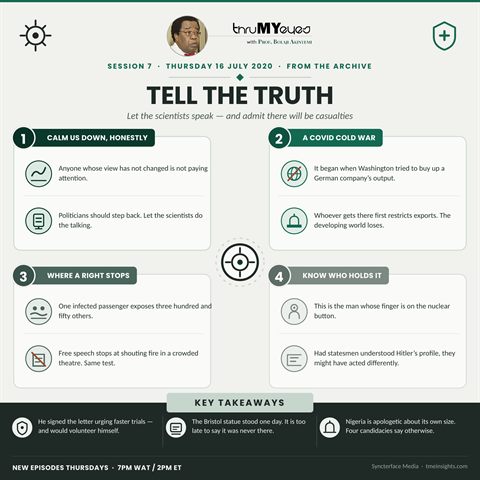 |
7 | Just Tell Us The Truth Governments insisting there is enough of everything, a vaccine race turning nationalistic, and a Professor who wants the politicians to step back and let the scientists speak — because a public told the truth can take casualties on the chin. | ||
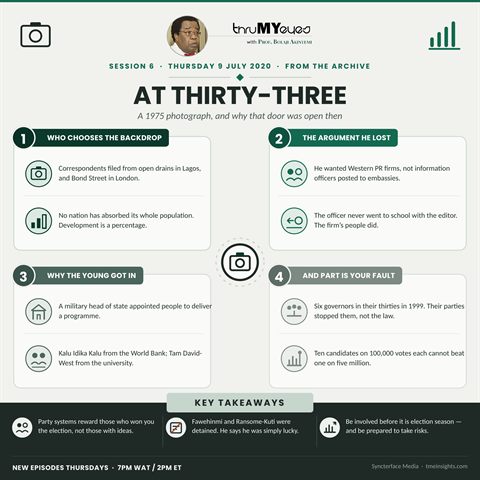 |
6 | Thirty-Three, And In The Room A photograph from 1975 goes viral and a generation asks the obvious question: how were you there at that age, and why is the door shut now? His answer refuses the easy grievance and lands somewhere less comfortable. | ||
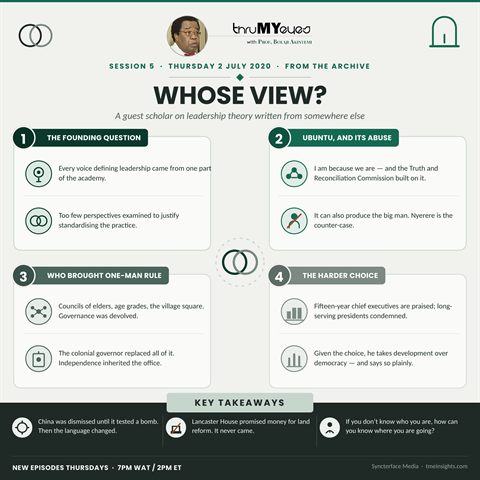 |
5 | Whose Point Of View? A guest scholar noticed that every voice defining leadership came from one part of the academy, and wrote a paper asking what the theory would look like written from somewhere else. The Professor agrees — and then makes a harder claim of his own. | ||
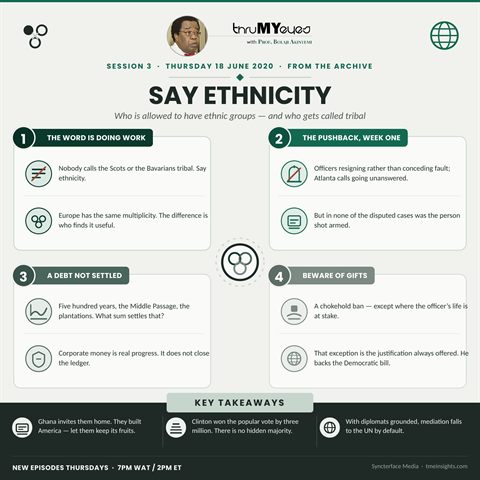 |
3 | Say Ethnicity, Not Tribalism A viewer asks about tribalism in Africa and gets the word itself taken apart — then an evening on who is allowed to have ethnic groups, what a five-hundred-year debt could possibly settle, and why the backlash arrived within a fortnight. | ||
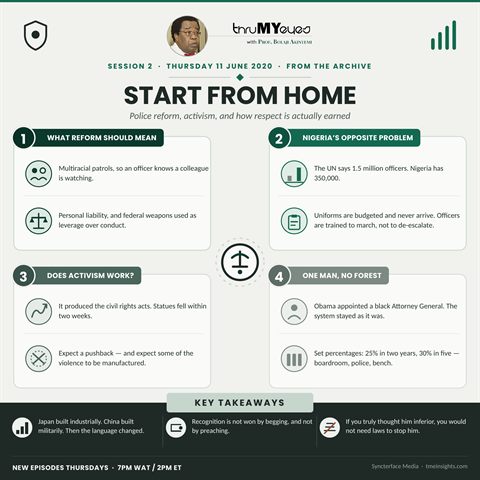 |
2 | It Has To Start From Home Two weeks after George Floyd's murder, the Professor sets out what police reform should actually contain — and then answers the harder question underneath it: how a people earns standing it is not being given. |
Ten of the earliest archive editions were written before the quadrant brief existed, so they show the session number instead.
The Weekly Foreign-Policy Briefing
One session. One argument. In your inbox.
Every issue distils the week's debate into a briefing you can read in minutes — with the clips and quote cards to share.
Published by Syncterface Media. Unsubscribe anytime. No spam.
Or download this issue as a PDF